Let’s be clear on a few basics at the outset. The number of Skeena bound summer steelhead exiting their central North Pacific Ocean rearing environment is unknown. Based on decades of experience, however, that starting population will landfall in Southeast Alaska. An unknown number and proportion of them will succumb to Alaskan nets, first at the hands of seine vessels at Noyes Island and second courtesy of gill nets at Cape Fox. The Alaska scenario commands more than the passing mention given here and will be dealt with in a future blog. Once in Canadian waters Skeena steelhead must navigate the outer parts of the Department of Fisheries and Oceans’ Statistical Area 3 and then south through Statistical Area 4.
The basic geography is illustrated in the figures below. Area 3 is a narrow band that extends seaward from the Alaska/BC border near Cape Fox on the north and from a parallel boundary about 16 km or 10 miles south. Area 4 begins at the southern boundary of Area 3 and continues south well past Kennedy Island. The highest steelhead encounter area, by far, is the area between the commercial fishing boundary seaward that includes the sub areas labeled River, Gap and Slough.
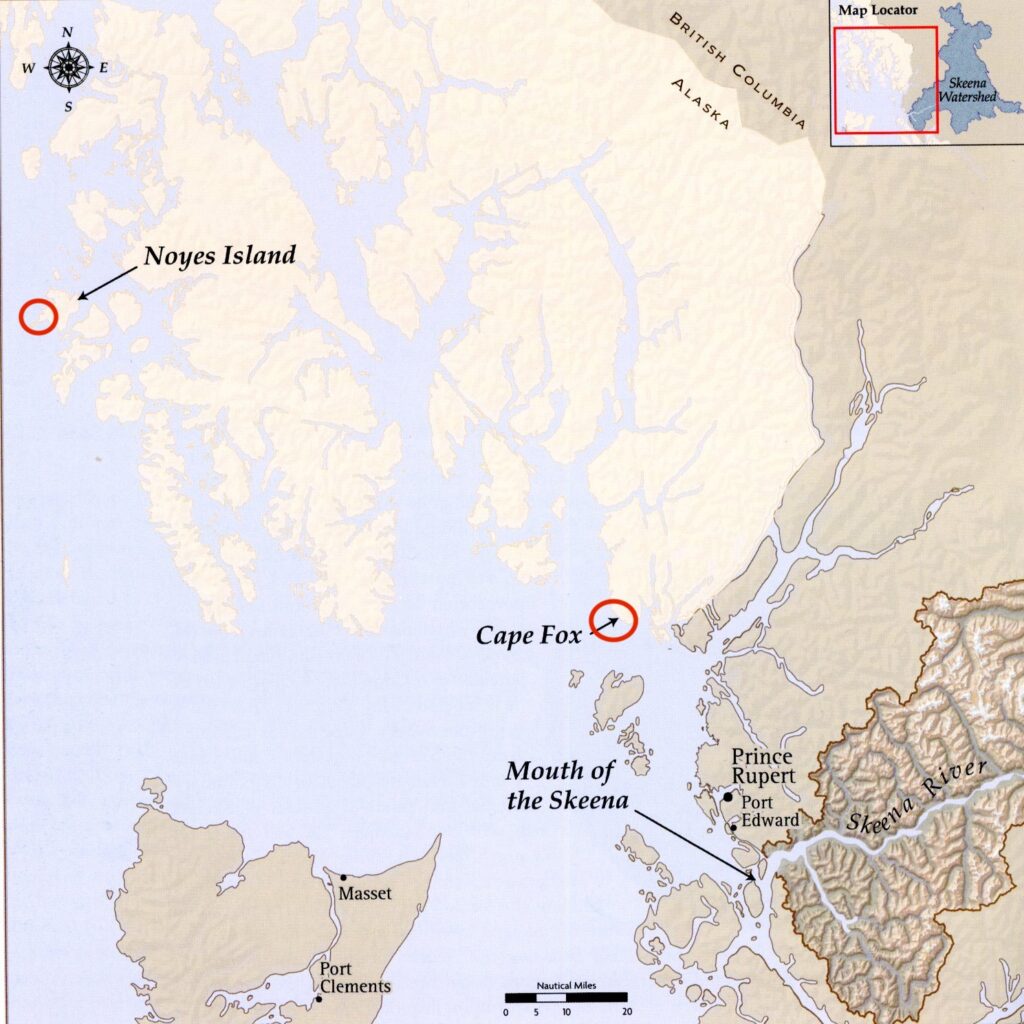
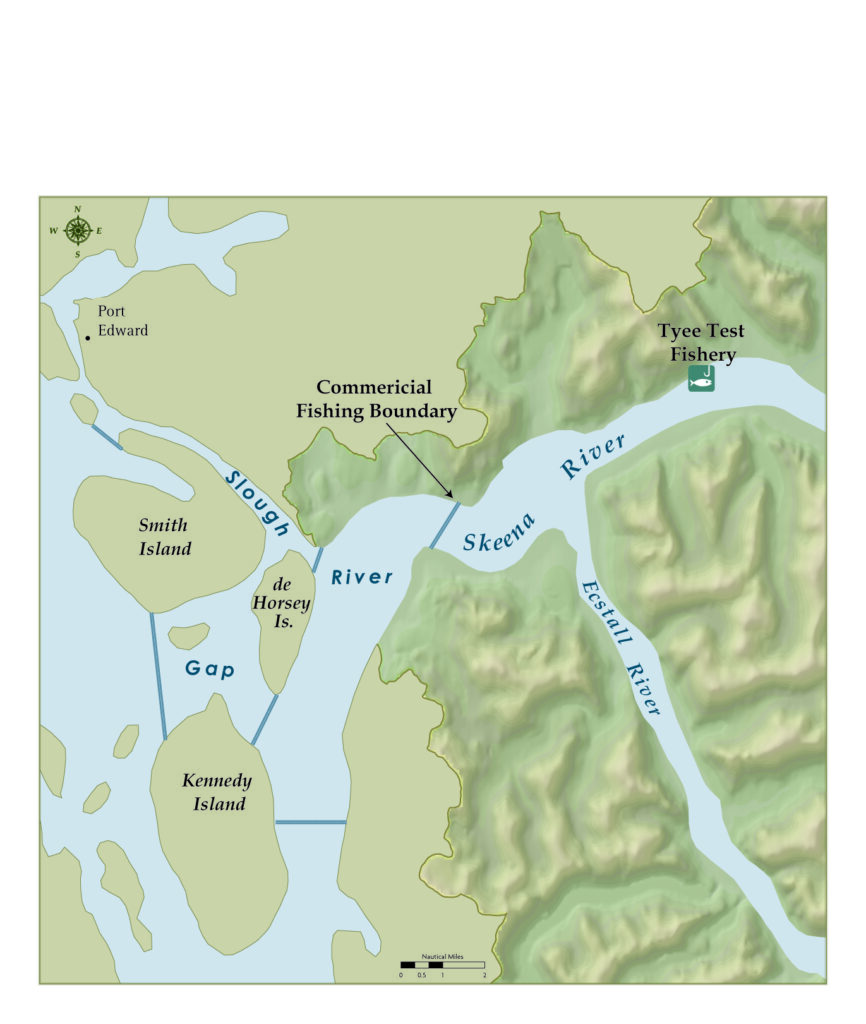
As a steelhead swims, it’s about 320 km or 200 miles from Noyes through areas 3 and 4 to the upstream limit of the commercial fishing territory on the lower Skeena. The first point at which a defensible estimate of the annual steelhead abundance is made is DFO’s test fishery at Tyee 10 km or 6 mi upstream. In fisheries jargon the Tyee estimate plus the combined commercial catches in SAs 3 and 4 is termed the Total Return to Canada or TRTC. Tyee provides daily estimates of the number of steelhead that didn’t succumb to nets enroute to the Skeena. The TRTC is highly speculative because the reported commercial catches of steelhead are always less than what actually occurs.
Many details on migration routes, fishing locations and boundaries, key interception areas, etc. are covered in “Skeena Steelhead – Unknown Past, Uncertain Future” published in 2011. Those interested can obtain a copy according to the information posted on my web page. What’s of interest in 2026 is an overview of what we know or can foreshadow based on realistic interpretation of available information.
A good starting point to appreciate what the fisheries management agencies say or, more properly, don’t say about the 2026 edition of Skeena steelhead is DFO’s draft Integrated Fisheries Management Plan. Those annual documents have become quite the undertaking. The North Coast edition is now 431 pages. (Fifteen years ago those documents were 100 pgs.) The steelhead entry in the 2026 plan reads as follows:
“Due to concerns over generally poor returns of Steelhead to the Skeena River, the Department and the Province of B.C. continue discussions on an approach to the management of Steelhead returning to the Skeena watershed, consistent with the 1999 fisheries management protocol between the federal and provincial governments. The Department intends to engage First Nations, stakeholders, and the Province of B.C. both bilaterally and as part of the 2026 IFMP planning process on Skeena Steelhead management.”
That’s it. One third of a page (less than 1/1000th of the overall document) devoted to a resource as valuable as Skeena steelhead! Inshore rockfish were accorded two pages. The 2026 entry is a carbon copy of those appearing in every IFMP for at least the past 9 years. I’ve made several requests for a copy of the annually mentioned 1999 fisheries management protocol so that I can refresh myself on what it says and how that may be influencing Skeena steelhead 27 years later. No response has ever been received.
Even though there is nowhere near the linkage between past and present returns for a complex life history species such as steelhead relative to the simple life history species (i.e. sockeye and pink salmon) that dominate commercial fishery interests, I’ll suggest there is instruction in examining the annual steelhead abundance estimates provided by DFO’s test fishery. For the past 7 years the average was 15,800, 45% of the preceding 7-year average of 28,550. But there was no commercial fishery in 3 of those most recent 7 years. Unless the Alaska situation is enormously different over these years than at any previous time, there is no case to be made that we shouldn’t be paying much more attention to our own back yard.
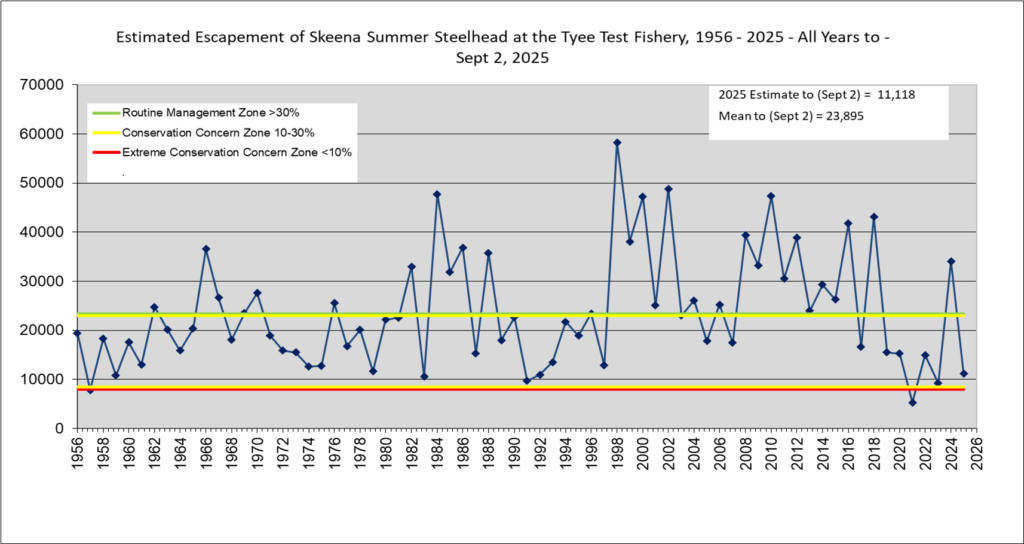
There’s more. Those recent 7 years have seen significant changes in the commercial gill net fishery in Area 4. The list includes major reductions in the number of participating vessels, fewer days fished per opening and per week, short nets, short sets, revival boxes, mandatory release of steelhead and even observers. Compare the recent test fishery estimates to those from 1991, 92 and 93, at the time among the lowest ever recorded and the only incidence of 3 successive years of such poor returns. The average of those years was 12,700 but that was when commercial fishing fleets of up to 800 vessels fished four and sometimes five days per week with none of these latter-day restraints. Call it the good old days from a commercial fishing perspective or a nightmare in the eyes of recreational fishers. Either way, the average return over those years was still 80% of the recent estimates. Imagine what the 2019 through 2025 test fishery numbers would look like with anything close to the early 1990s effort? Even with no openings in 3 of the past 7 years, fleet sizes at 15% of what they once were during scheduled openings, cumulative total gill net boat days per season around 20% of those early 90s levels and effort sharply curtailed by the first week in August, the downward trend in steelhead abundance is unaltered.
Given their lack of visibility over the past many years, one would be hard pressed to acknowledge either the federal or provincial fisheries managers as anything other than passive observers of the annual Skeena steelhead return. Beyond the traditional two governments, though, we now have the third level, First Nations, plus a long list of non-government organizations eager to market themselves as players with significant influence.
Two years ago, I put together a list of Skeena FNs whose traditional territories bracket the Skeena and its tributaries. I made the number to be six. Beginning at the coast and proceeding inland we have Tsimshian, Kitsumkalum, Gitanyow, Gitxsan, Wet’suwet’en and Lake Babine. Within each of those primaries there are various components. For example, the Gitxsan organization includes Huwilps, Wilp, Pdeeks, hereditary chiefs, elected chiefs, etc. whose interactions and responsibilities I don’t pretend to understand. The point is each of the six First Nations is a separate government the courts, government regulations and policy have set up as the last voice on anything contemplated in their traditional territory. Decisions stemming from such process are negotiated government to government, behind closed doors. The general public is not involved until announcements are made. Steelhead are rarely a target species for any First Nations fishers. Non-indigenous anglers are broadly criticized by First Nations spokespersons for “playing with their food”.
Beyond the individual First Nations with traditional territories that include the Skeena’s entire steelhead producing habitat there are a number of independent FN groups with major influence on all that transpires between indigenous people and, especially, the provincial government. All of these have web sites that anyone interested can access readily to decide for themselves how confusing all this is. A partial list:
- First Nations Leadership Council, comprised of political executives of the BC Assembly of First Nations, the First Nations Summit and the Union of BC Indian Chiefs. Each of the three has a separate web site.
- First Nations Fisheries Council
- Skeena Fisheries Commission
- Skeena First Nations Technical Committee
- Skeena First Nations Fish Secretariat
- The North Coast-Skeena First Nations Stewardship Society
- Gitksan Watershed Authority
Who does one communicate with regarding steelhead concerns? Through what protocols?
On the NGO front, steelhead issues become even more confusing. The money involved is staggering relative to that of the budgets for conventional fisheries agencies. The Moore Foundation, for example, announced in November 2025 a sum of $12.5M over 26 months “to support durable conservation in Northwest British Columbia”. That’s the only description given for the intended purpose of this money. I understand it is funnelled through the Oregon based Wild Salmon Center that recently enticed the Executive Director of the Terrace based Skeena Wild Conservation Trust to join them to head their new BC Program. Can there be any doubt that a good part of the $12.5M flows from its source to Skeena Wild. Is it unreasonable to ask how that money benefits Skeena steelhead?
Next, we have the floating fish trap project on the lower Skeena. It was announced to be patterned after the Columbia River pound trap operation. The original 2024 budget of $2.27M went to the Lax Kw’alaams Business Development Corporation (Tsimshian First Nation) from the taxpayer funded government program known as the BC Salmon Restoration and Innovation Fund. The pound trap never happened. Instead, a floating trap was substituted one year later. The Duval Washington based Wild Fish Conservancy was contracted to design the pound trap in 2024 and the floating trap in 2025. My questions to BCSRIF about additional budget to facilitate the major changes in 2025 remain unanswered. Meanwhile the BCSRIF program has been cancelled effective March 31, 2026. I’m told there are reporting requirements but all such information, including any documentation related to the WFC involvement, is subject to contractual agreements such that reports may never be made available to anyone beyond project personnel. What I have been able to determine, however, is the trap operated for the 3 months that bracketed the 2025 steelhead return. I understand it caught 109 steelhead, all of which were DNA sampled, scale sampled and 90 of them radio tagged. Thirteen fixed station receivers were deployed at various upstream locations. Helicopters were also employed to track radio tagged fish. It’s instructive that the floating trap’s sockeye catch amounted to the equivalent of 10% of a single day’s harvest by the commercial gill net fleet in Area 4.
Further upstream, just above Terrace, we had the Kitselas Band operating a fish wheel. That one was much publicized by supporters from Skeena Wild, the BC Federation of Fly Fishers, the Steelhead Society, Watershed Watch and a Terrace based First Nations job procurement and employment opportunity group known as k5tclubhouse. Once again, multiple requests for the number of steelhead caught and what sampling or tagging may have occurred remain unanswered. Interestingly I found no evidence that the wheel operators were aware of fish being tagged at the floating trap or the Tyee test fishery. If any tagged steelhead were encountered there was never any report provided to any of the federal or provincial fisheries staff. I also discovered that none of the 2025 cast of players was aware that the consulting firm LGL had operated 3 and sometimes 4 fish wheels at the same site 30 years ago. A very comprehensive report of their results was passed on to the recent participants. The results of the mid-1990s undertakings did not exactly match what the 2025 crew was forecasting and marketing.
Continuing – the Native Fish Society headquartered in Oregon City joined the Skeena steelhead devotees through another group known as the Babine River Foundation, a Babine guide headed, patron funded group partnering with yet another US based group, The Conservation Angler. That one has announced plans to compile “a long-term steelhead demographics data base” (their terminology) by sampling guided angler caught Babine steelhead. No indication has been given with respect to how this will benefit the broader Skeena steelhead scenario.
The common theme among all these groups is there isn’t one. All are comprised of well educated, well organized, capable and enthusiastic people that are largely independent of one another. Money supply is not the problem. It’s distribution is. Co-ordination of strategies, objectives and methods is sadly lacking as is tangible evidence of accomplishments that might actually move the steelhead dial or at least contribute to things that might. Neither federal nor provincial fisheries management staff are involved in any detectable way with any of these groups’ programs. Wouldn’t it be more productive for all three governments and all those NGOs to be working from the same playbook? Surely the steelhead advocacy community can do more than watch from afar with fingers crossed for a collapse of the enhanced Babine sockeye return.
Next up, Alaska. Following that some suggestions for actions that would make a difference.