A useful starting point to frame discussion around Skeena steelhead and what happens to them is a brief summary of who’s who in the steelhead management scenario in British Columbia today.
Traditionally, there were two government jurisdictions, one federal, the other provincial. Federally, it’s the Department of Fisheries and Oceans (DFO). Provincially, it’s the Ministry of Water, Land and Resource Stewardship (WLRS). The former is functionally unchanged for decades. Ottawa is headquarters, Vancouver is mission control for Pacific fisheries in general and Prince Rupert is the office dealing with the northern half of the coast of BC, including the Skeena.
The provincial government has undergone several re-organizations over the past decade. Those have seen the steelhead managers punted from place to place. The most recent landing spot, WLRS, is only five months old. Its minister resides in Smithers, the location of the office housing the Skeena steelhead managers. It is not unfair or inaccurate to state the provincial steelhead management scene is completely dysfunctional. Mostly good people but constrained politically and financially to the point they couldn’t do what’s best for steelhead if they wanted to.
Federal government jurisdiction includes tidal waters fisheries as well as First Nations fisheries, both tidal and non-tidal. The province is responsible for non-tidal recreational fisheries. The ageless problem is the tidal commercial fisheries targeting salmon whose timing overlaps far less abundant steelhead.
The First Nations fisheries have grown substantially over the past 30 years pursuant to consecutive supreme court decisions in their favor. Individual FNs are now accorded government status. In other words there are now three governments to deal with on steelhead management. In river harvest of Skeena steelhead by FNs is an obvious concern but not one anyone in the traditional government management agencies has significant influence over, now or in the foreseeable future.
In attempting to understand why steelhead are little more than a minor inconvenience in terms of government priorities, it is instructive to look at some demographics. The BC population stands at about 5M today. It is projected to increase by 50% within 22 years. More than 90% of that population resides in the southwest corner of the province (Vancouver through lower Fraser Valley plus the southeast coast of Vancouver Island). Less than 1% of BC’s population call the Skeena watershed home. Indigenous people represent the fastest growing segment of the BC population. The Skeena watershed origin First Nations members comprise a disproportionate component of the overall regional population relative to other areas of the province.
The number of licensed BC anglers who purchase steelhead angling licenses is now about 18,000 annually (latest data available from 2021 season). That figure has not changed significantly for the past 10 years. About 40% of those licensees reported they never went fishing. Again that figure has not changed significantly for a decade. The point to appreciate here is just how miniscule the steelhead angling community is and how little voting power it represents. My liberal estimate of the number of steelhead anglers who belong to any group that might be labeled as steelhead advocates is less than 10% of licensees. Those people typically share widely differing views, so much so that a consistent voice on behalf of steelhead is an elusive dream. Even if all the active steelhead anglers in the province ever found themselves on the same page their voice is just not going to be heard by the politicians who control the controllable fisheries management outcomes.
Now, on with steelhead abundance scene. The time series data from the Department of Fisheries and Oceans’ Tyee test fishery is the best illustration. The data originates from a DFO contractor instructed to make a one hour set on every slack tide during daylight hours over the duration of the fishing season. That fishery has been conducted, essentially unchanged, at the same site, just upstream from the commercial fishing boundary at the mouth of the Skeena River since 1956. The results of the test fishery sampling are shown below.
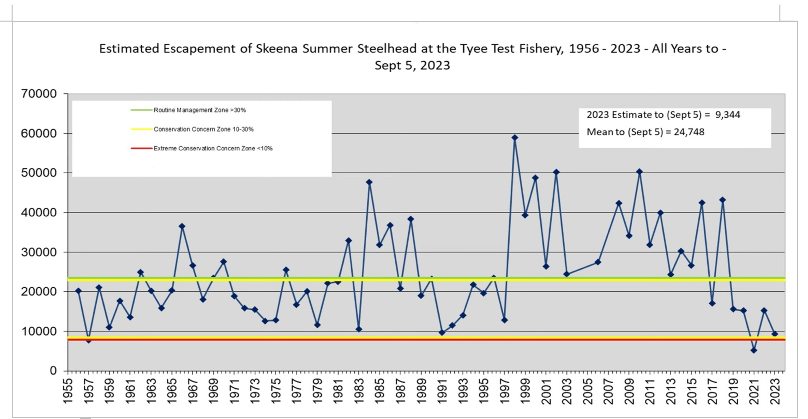
Figure 1: The estimated number of steelhead entering the lower Skeena River as determined by the Department of Fisheries and Oceans Tyee test fishery.
It is important to understand these estimates are not spawning population estimates. They represent the number of steelhead that didn’t get caught by various fisheries before arriving at the test fishery site. Those numbers are further reduced by a variety of upstream factors, including First Nations fisheries, catch and release angling mortality, poaching, predation and perhaps even disease related to at least some of those other factors.
The colored lines warrant clarification. The red one was adjusted downward in 2021 when the critical conservation status of steelhead was undeniable. The rationale for the re-definition of the boundaries became the subject of a once in a lifetime letter co-authored by ten retired Province of BC fisheries management staff, half of them veterans of the Skeena Region. The letter dated September 6, 2023, was prepared as the numbers came in suggesting the prescribed extreme conservation concern threshold would not be met. Its authors requested a thorough, written rationale for the 2021 change and recommended an independent review of whatever document was produced. It was sent to the political heads of the two government departments that shared responsibility for Skeena steelhead at the time. The restructuring of the province’s ministries in (referenced previously) shortly thereafter landed full responsibility for steelhead with only one of them. No response to the letter has ever been received.
Those colored lines denoting “routine management”, “conservation concern” and “extreme conservation concern” are deceptive. Consider the 13-fold difference between the peak abundance in 1998 and the lowest ever in 2021. Over that range there was never a single measure taken that had any significant influence on the steelhead spawning population size. How can that be interpreted as anything other than “routine management”? Those earlier years are not something anyone can influence today but they do serve as a barometer of the inertia of the government managers. Can anyone offer another example of a high-profile fishery that remained exempt from any management action over such a range in abundance?
It is widely held that commercial fishing is the primary factor in reducing Skeena steelhead abundance. An examination of the extent of commercial fishing and the trend in its impacts can be appreciated by reference to the following figure for 1991 relative to the two most recent years (see 1991, 2022, 2023 in Figure 1).
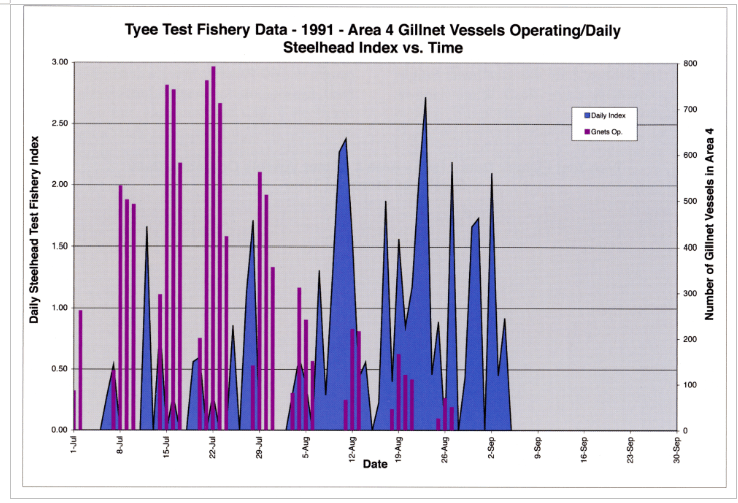
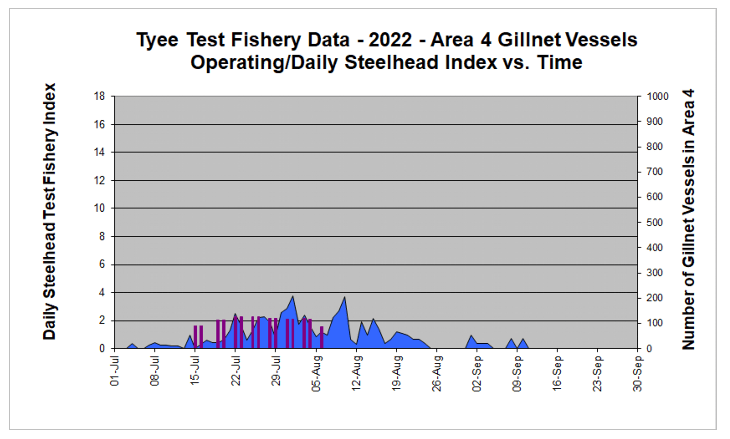
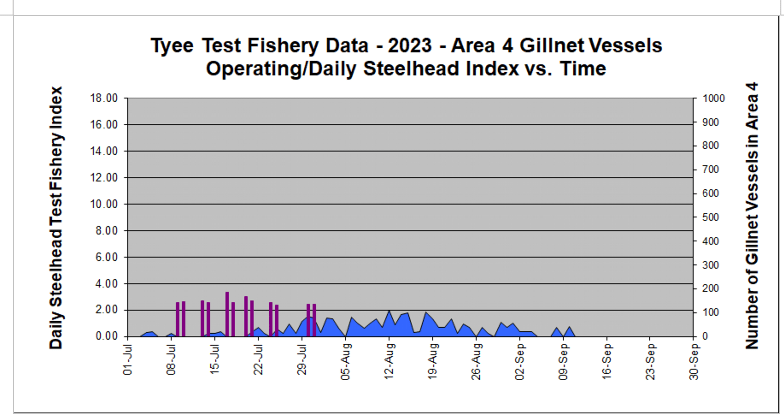
People should not be under the illusion the Canadian commercial fishery impacts are the force they once were. That isn’t to say a fleet of 120 gill nets concentrated in the throat of the Skeena on top of a steadily declining steelhead return doesn’t remain an issue, but it isn’t the only one.
Whereas the conventional commercial fishing pressure is significantly less than it was three or four steelhead generations ago, any relief from that impact has been offset to some degree by the fishing prosecuted by First Nations. The “food, social and ceremonial fisheries” that occur in the conventional commercial fishing areas at the mouth of the Skeena, throughout the mainstem and even in some of its tributaries are now much more significant than ever before. That is the consequence of that succession of court decisions progressively opening doors. That trend will never be reversed.
Obviously the amount of commercial fishing authorized in the area well understood to be the most impactful to Skeena steelhead (i.e. “Area 4”) is a fraction of what it was three decades ago when Skeena steelhead conservation was vaulted into the spotlight as never before (1991, 1992 and 1993). Today’s fleet size, days fished, and season duration are markedly less than in bygone days. In fact, there was no commercial fishing in Area 4 in 2019, 2020 or 2021. Imagine what those estimates of the number of steelhead passing the DFO test fishery would look like if there had been anywhere near the gill net fishing of the 1990s.
Then we have the recreational fishery influence. Ever since the implementation of catch and release regulations in the 1990s, the assumption of most people connected to the recreational fishery is there is no harm done. What is never considered is how much catching is too much catching?
Today’s rec fishery is distantly removed from that of the 1970s and 80s when it was dominated by local residents, relatively small numbers of visiting anglers and a handful of guides, most of whom conducted business only to subsidize their angling habit while enjoying time away from their regular jobs. Now there is a once unimaginable cadre of licensed guides with unlimited numbers of assistants, not to mention unlicensed guides, operating from the lower reaches of the mainstem Skeena to the headwaters of every tributary where steelhead can be pursued legally. Nowhere marketable is exempt from angling facilitated by helicopters, jet boats, inflatables, or the ever-expanding network of resource development roads. The efficiency and exploitive capacity of today’s recreational fishery bears no resemblance to what the steelhead of three or four generations ago experienced. All this is superimposed on steadily diminishing stock sizes.
Figure 1 illustrates plainly we’ve had five consecutive years of poor steelhead escapements. The large majority of progeny of those returns are either at sea already or will be this spring or next. Their pastures in the Gulf of Alaska and central north Pacific have experienced the highest sea surface temperatures on record during most or all of their ocean residence. That is not good news for a species known to reside in that zone virtually continuously. Preferred food supplies are minimal at best. Steelhead that manage to survive “ocean conditions” and get beyond the lower Skeena test fishery are forecasted to see another year of extreme low, warm water. Tributaries critical to their reproduction are likely to experience a repeat of 2023 when some were sub-surface or intermittent.
There is enough science and reliable accounts around today’s rec fishery for Skeena steelhead to generate an angling management plan that recognizes there is a relationship between steelhead supply and angler demand. Sadly, though, additional constraints on anglers are perceived as economic disaster for communities such as Smithers and Terrace. Conservation of business, not steelhead is the priority, just as it was in 2021. Further, there is deep concern that restrictions would further divide the angling catering community and destroy any prospect of a consistent public voice being heard by politicians who might be willing to deal with Alaskan interception of Skeena salmon and steelhead. The web sites of the prominent booking agents for the high-profile fishing lodges throughout the Skeena reveal nary a hint 2024 won’t be business as usual.
Before I leave off, readers might find it instructive to consider a list of some of today’s NGO players influencing Skeena steelhead futures.
- The Pacific Salmon Foundation with its recently released summary of the status of BC steelhead. It can be found at https://salmonwatersheds.ca/document/lib_598/
The best description I’ve seen of that document comes from one of the ten co-authors of that unanswered letter referenced earlier. “Consultants telling me that more monitoring and documentation of the decline is necessary, to provide more work for consultants.” Those who look up the PSF document will notice it is openly critical of the province for refusing to provide data known to exist. They might also notice there is virtually no mention of angling impacts and nary a word critical of anything associated with First Nations.
- Watershed Watch and Skeena Wild Conservation Trust leading the anti-Alaska campaign.
- The Washington based Wild Fish Conservancy. It recently received $2.21M of Canadian taxpayer dollars to partner with some Skeena First Nations to build and operate a fish trap near the DFO test fishery. I requested some detail around the proposal from both its lead WFC proponent and the Smithers office. WFC never responded and Smithers claimed it didn’t know anything.
- The Oregon based Wild Salmon Center conducting DNA research on Babine steelhead on behalf of the guide headed Babine River Foundation.
- Upper and lower Skeena angling guide associations.
- Obligatory multi-tiered angling advisory committees and boards (both federal and provincial).
- Individual sport fishing advocacy groups such as the BC Federation of Fly Fishers and the Steelhead Society of BC.
- The Gitxsan Watershed Authority (GWA).
- The Skeena Fisheries Commission and its companion Skeena First Nations technical Committee.
Most of these are independent of the others and operating in isolation of any detectable or productive connection with the provincial steelhead managers.
There is an abundance of evidence pointing to the need to soften the angler footprint. It’s the only card the steelhead managers have to play. Options for how that could be realized have been offered many times from the late 1990s onward. None have been acknowledged, much less investigated. Instead they invest in things like observer programs to confirm the obvious for the umpteenth time – commercial gill nets kill steelhead that don’t get reported. And the managers continue to ignore that Witset program that is the single most damaging influence on the steelhead stock that once supported the largest recreational fishery in BC.
Draw your own conclusions. In the meantime, pray for a poor return of Skeena sockeye, some serious snowfall and a wet summer.
R. S. Hooton. February 28, 2024